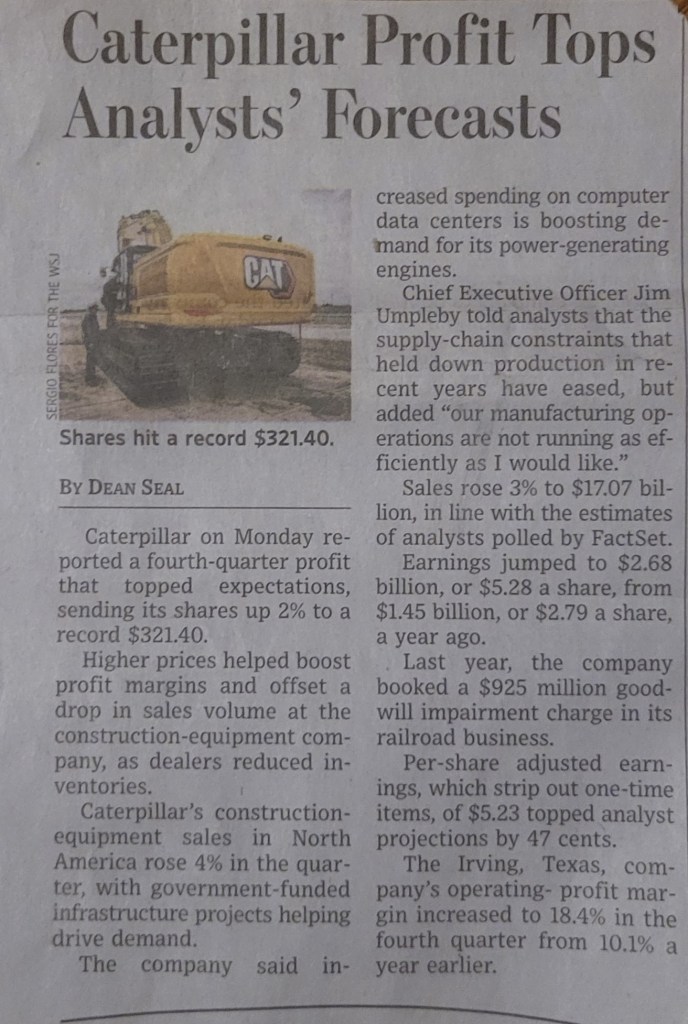
WSJ: Caterpillar Stock on Track for Record High After Earnings Beat Forecasts
Few levers hold as much power to influence profitability and eventually, stock price growth as effective price management. I also find that it is often the most underutilized lever for many reasons. Let’s take a look at Caterpillar’s stellar performance in the fourth quarter, where higher prices played a pivotal role in boosting profit margins and driving investor confidence to new heights.
Caterpillar, renowned for its excavators and bulldozers, reported fourth-quarter profits that surpassed expectations, sending its shares soaring to record highs. Despite a drop in sales volume, the company’s strategic focus on pricing proved instrumental in navigating challenges and seizing opportunities in the market.
Here’s how Caterpillar leveraged price management to achieve remarkable results:
- Margin Expansion through Higher Prices: By strategically raising prices, Caterpillar effectively expanded its profit margins, offsetting the impact of lower sales volume. This demonstrates the significant impact that pricing decisions can have on the bottom line, especially in industries characterized by fluctuating demand and supply dynamics.
- Market Demand and Pricing Strategy Alignment: Caterpillar’s ability to capitalize on government-funded infrastructure projects and increased spending on data centers highlights the synergy between market demand and pricing strategy. By aligning pricing decisions with market trends and customer preferences, the company can maximize revenue generation while delivering value to its customers.
- Investor Confidence and Stock Price Growth: The market’s positive response to Caterpillar’s earnings report underscores the crucial link between price management, profitability, and stock price performance. As investors recognize the efficacy of the company’s pricing strategy in driving financial performance, confidence in its future prospects grows, fueling upward momentum in its stock price.
- Operational Efficiency and Pricing Optimization: While Caterpillar acknowledged challenges in operational efficiency, its success in achieving per-share adjusted earnings that surpassed analyst projections highlights the importance of pricing optimization in mitigating operational constraints. By optimizing prices relative to costs and market conditions, companies can enhance overall profitability and shareholder value.
Caterpillar’s impressive fourth-quarter performance serves as a compelling case study on the transformative power of price management. As businesses navigate increasingly dynamic and competitive markets, the strategic importance of pricing decisions cannot be overstated. By adopting a data-driven approach to pricing, companies can unlock new avenues for growth, strengthen their competitive position, and ultimately drive sustained profitability and shareholder value.
In conclusion, Caterpillar’s success story reaffirms the adage that price management is not just a tactical consideration but a strategic imperative for businesses seeking to thrive in today’s complex business environment. By harnessing the power of pricing, companies can chart a course towards sustainable growth, resilience, and prosperity in the years to come.
 Pricing, well played.